Repowise - a codebase index that caught my eye
A tool that indexes your repository once and lets your AI agent read the answers instead of grepping everything again. I have not tried it yet, but it looks very promising.
I have not tested this one yet. But it caught my eye, and after my headroom post it fits the theme of this blog perfectly, so I'll write it down before it disappears into a bookmark folder.
What it is
Repowise is a Python tool that builds a single index of your repository: dependency graph, git history, code health scores, generated documentation, and mined architectural decisions. That index then serves both you and your AI agent. Around 5900 stars, open source under AGPL-3.0, and everything runs locally: pip install, no cloud, and the basic index works without any API key.
What caught my eye
The MCP part first. Repowise exposes ten MCP tools for Claude Code, Codex, Cursor and VS Code, built around tasks instead of single files and symbols. The idea is that your agent stops re-discovering the codebase on every task, and reads a precomputed answer instead. The README claims 35x fewer tokens to load a commit's context and 31.6% less output tokens in a measured agent loop. I take numbers like that with a big grain of salt, but I like that they publish the benchmark methodology and even the rows they lose.
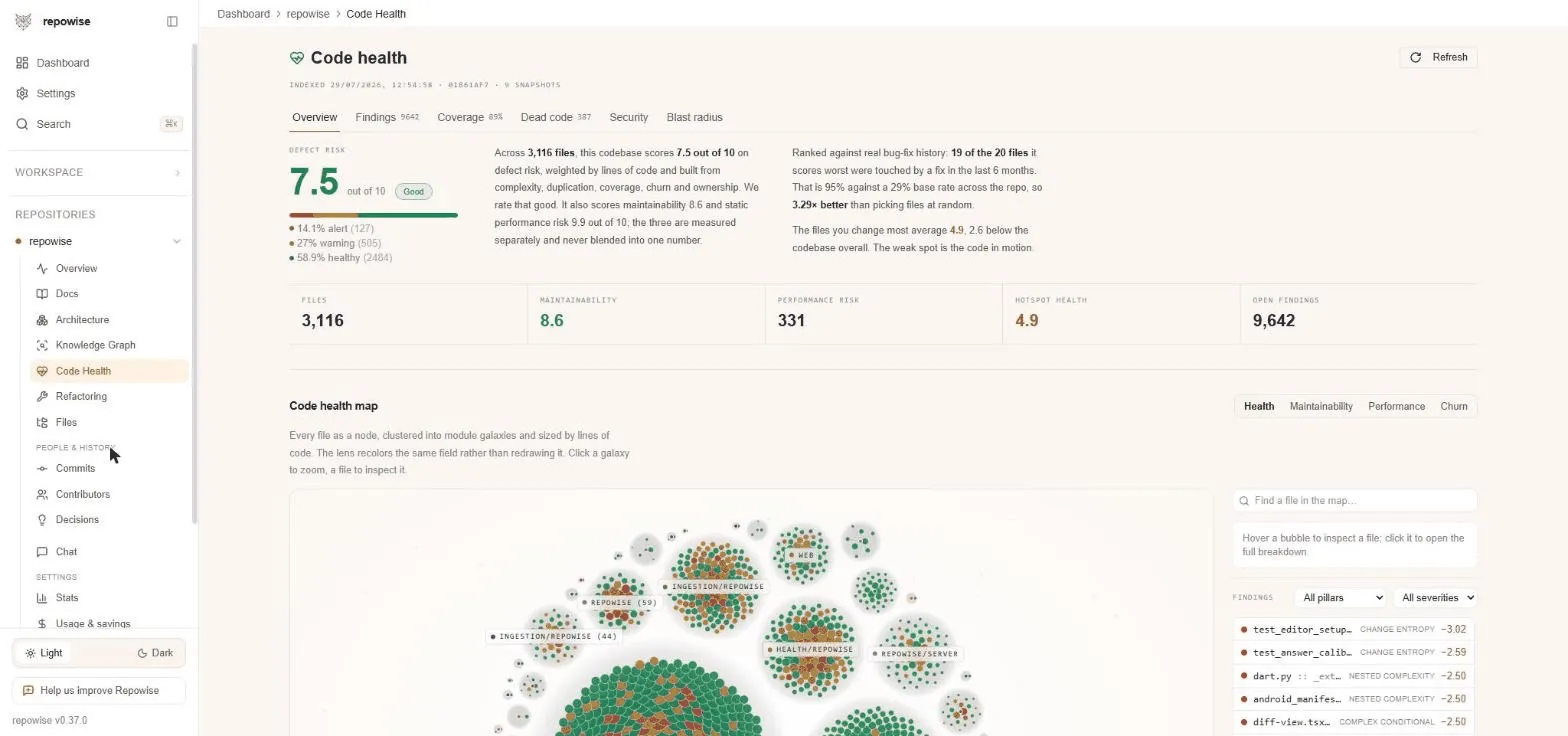
Then the code health score. Every file gets a score from 1 to 10, computed by 49 deterministic detectors with zero LLM involved, plus concrete refactoring plans attached: extract class, break a cycle, move a method, with the exact symbols that have to move. A tool that tells you which file is the actual problem and what to do about it, without sending anything to a model, is rare.
And the distill command speaks directly to me. It compresses shell output before the agent reads it, keeps the errors and the exit code, and can expand everything back on demand. Given how much I liked headroom, this hits the same nerve.
On top of that there's a local dashboard on localhost:3000, a PR bot that comments once per pull request and stays quiet when the change is fine, and a wiki generated from your code structure without any LLM calls.
Anything to be careful about
It's AGPL, which matters if you ever bundle it into a commercial product. It's Python, so it brings a Python environment with it. And the claims are strong, so I want to see them on my own repos before I fully believe them.
I'll install it soon and report back with a real opinion. If it keeps its promises, it could fix a big chunk of the token waste I keep writing about here.
Keep reading